


In the high-octane, testosterone-fueled world of combat sports, Ryan Hall stands apart. With a stoic demeanor, an unassuming physique, and a penchant for articulate, philosophical post-fight interviews, he looks more like a university professor than a cage fighter. Yet, once the match begins opponents often find themselves snared in a web of complex entanglements that seem almost inexplicable.
Known affectionately as “The Wizard,” Hall’s career is not defined by brute strength or explosive athleticism, but by supreme intellect. He is one of the rare figures who didn’t just compete in BJJ, he actively changed how it is played, before taking his highly specialized game to the unforgiving arena of the UFC.

The Origin Of The Intellectual Grappler
Ryan Hall’s entry into martial arts was almost cliché in its origins, but unique in its execution. Growing up in Arlington, Virginia, Hall wasn’t a lifelong athlete. He was an intellectual youth who by his own admission found himself on the losing end of a physical altercation during his college years. That moment sparked a realization, he needed a systematic way to handle physical confrontation.
He didn’t turn to boxing or wrestling, instead he found submission grappling.
What set Hall apart immediately was his approach to learning. He treated grappling less like a sport and more like an engineering problem or a complex mathematical equation. He didn’t just drill moves, he deconstructed the underlying mechanics of leverage and anatomical structures.
This analytical mindset led to a meteoric rise through the belt ranks. Hall became an internet sensation in the mid-2000s, known as a “purple belt prodigy” whose competition footage circulated on forums, showing him dissecting black belts with bizarre, inescapable sequences.
The 50/50 Revolution And ADCC
Before the “Danaher Death Squad” made leg locks de rigueur in modern grappling, Ryan Hall was already deep in the trenches of the forbidden game.
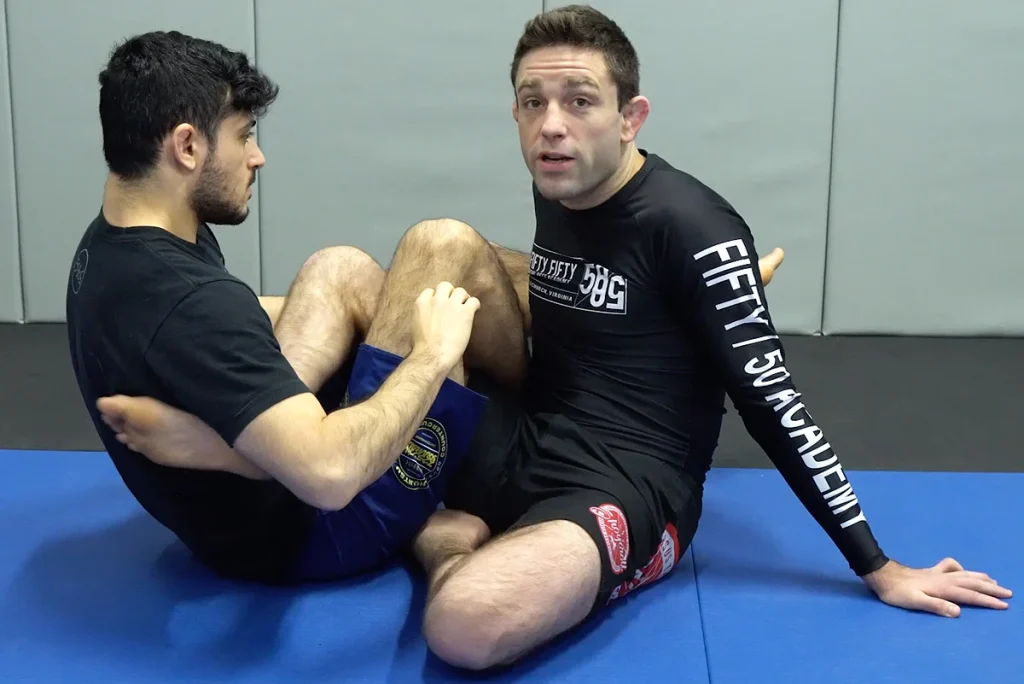
While he didn’t “invent” the 50/50 position, a neutral entangled leg position where both grapplers have equal offensive options, Hall is widely credited with systematizing it. In an era when IBJJF rules penalized “reaping” and many gyms shunned leg attacks as cheap or dangerous, Hall embraced them.
He developed a comprehensive system from the 50/50, using it not just to stall, but to sweep, take the back, and, most notoriously, enter into devastating heel hooks.
His seminal moment in pure grappling came at the 2009 ADCC Submission Wrestling World Championship in Barcelona. Entering the prestigious 66kg division, Hall utilized his unique guard game to secure a bronze medal, defeating elite competitors and proving that his cerebral, “sport-oriented” style could work at the highest level of nogi grappling.
Through his popular instructional DVD series, Hall democratized this knowledge. He taught a generation of grapplers that the guard wasn’t just about closed guard and spider guard, it could be a dynamic system of inversion and leg entanglement. He laid much of the groundwork for the modern, leg-lock-heavy meta-game we see today.
The MMA Experiment
Many grapplers, especially those heavily reliant on the guard, struggle when transitioning to MMA. The threat of strikes usually dismantles complex guard systems. Critics argued Hall’s game was too specialized, too reliant on the “gentleman’s agreement” of pure grappling, to succeed in a cage.
Hall proved them wrong by adapting, not abandoning, his base.
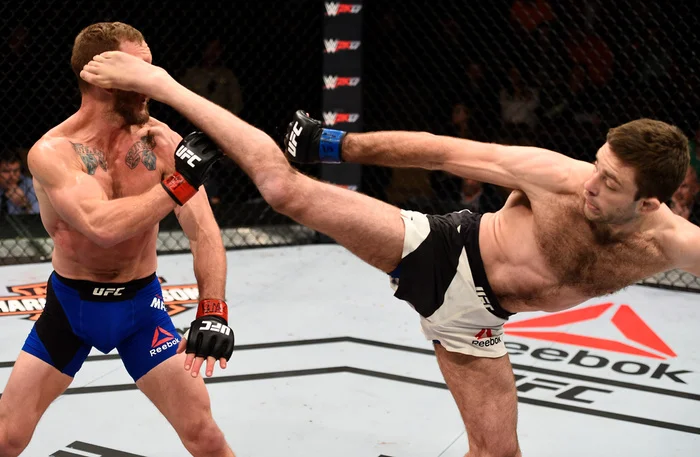
Gaining mainstream fame by winning Season 22 of The Ultimate Fighter as part of Team Faber, Hall showcased a bizarrely effective MMA style. He used rangy, flickering kicks to maintain distance, and if an opponent closed the gap aggressively, Hall wouldn’t sprawl, he would roll underneath them, instantly hunting for legs. It was terrifyingly unconventional and incredibly difficult to train for.
The Heel Hook Heard ‘Round the World
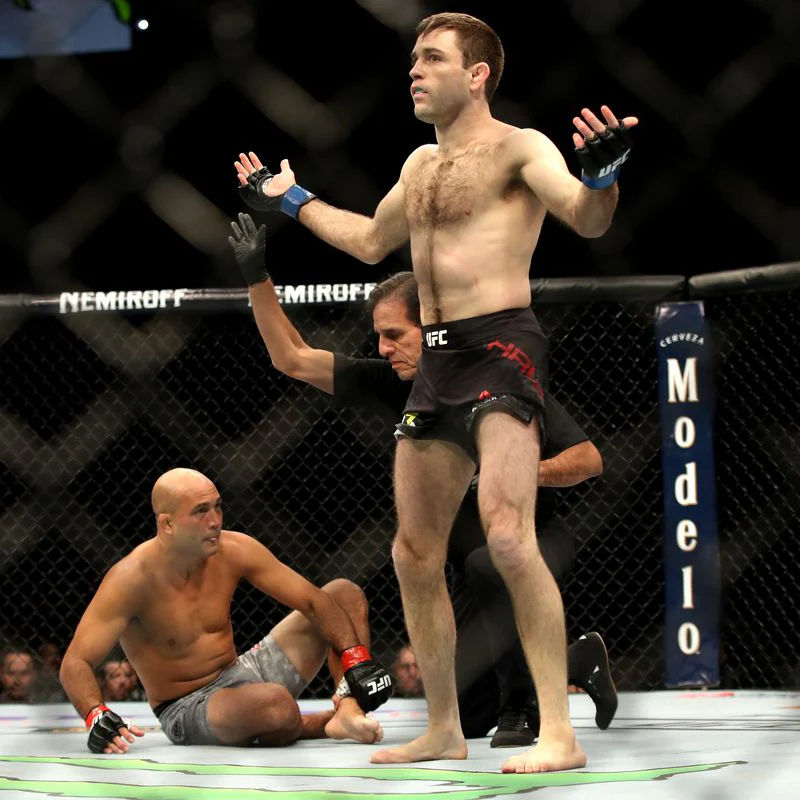
The apex of Hall’s MMA career, and perhaps the supreme validation of his life’s work in grappling, came at UFC 232 in December 2018 against the legendary B.J. Penn.
Penn, one of the greatest lightweight grapplers in MMA history, was expected to have the savvy to avoid Hall’s tricks. In the first round, Hall threw a low kick, and as Penn planted his foot to counter, Hall initiated an Imanari roll, diving shoulder-first toward Penn’s ankles.
In seconds, Hall had secured the leg, transitioned to a heel hook, and forced a frantic tap from the legend. It was the first time Penn had ever been submitted in a non-title fight. The submission was flawless, violent, and technically perfect. It sent a shockwave through the MMA community: the complex, modern Jiu-Jitsu game worked at the elite level of fighting.
The Wizard’s Legacy
Ryan Hall’s career has been occasionally marked by periods of inactivity, often due to high-ranked opponents refusing to fight him, a testament to the high-risk, low-reward proposition his unique style presents.
Regardless of his future in the cage, Hall’s legacy is secure. He is a bridge between eras. He took the “soft art” and applied a hard, scientific methodology to it. He proved that one could be a world-class fighter without being an overwhelming athlete, provided one possessed overwhelming technical knowledge.
In BJJ academies around the world today, when a white belt inverts to attack a leg, they are walking a path that Ryan Hall helped pave. He remains one of the most influential martial arts thinkers of his generation, forever the Wizard who engineered a new way to fight.


