

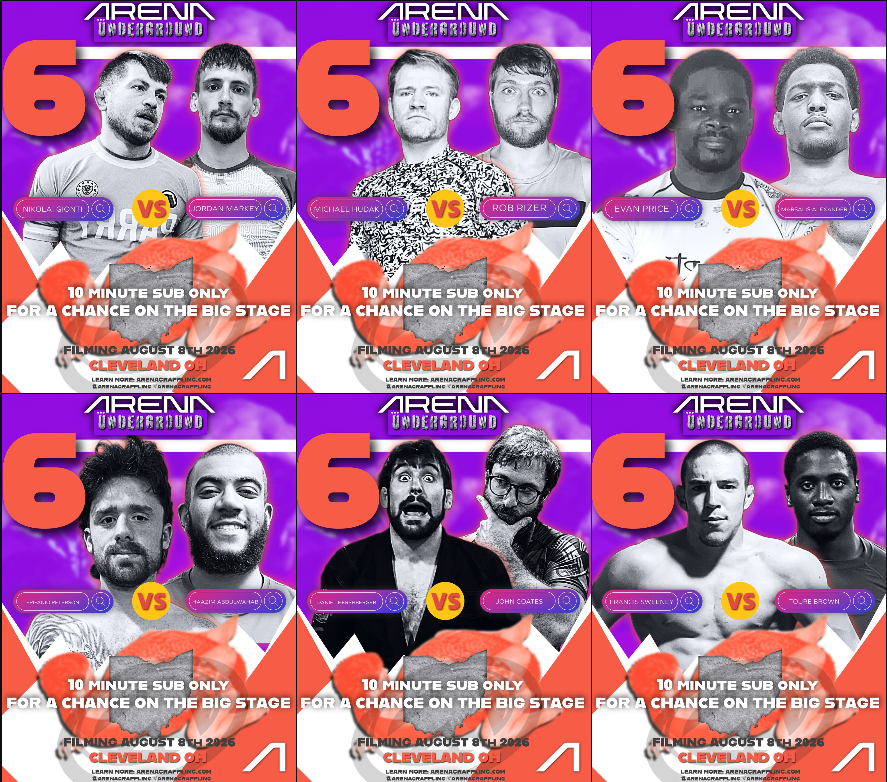
Arena Grappling has announced one of the most significant strategic shifts in its history, moving away from a busy annual event schedule in favor of a premium, two-event model centered around blockbuster live productions and a new developmental circuit called Arena Underground.
In a press release issued Tuesday, the promotion said it will now build its competitive calendar around just two marquee events each year: its flagship numbered Arena card and its annual Halloween showcase.
Rather than viewing the reduction in major events as a retreat, Arena is presenting it as an investment in quality. As a competitor on their upcoming underground card in Cleveland, I love what I’m hearing!
“We aren’t slowing down—we’re leveling up,” said Trova Media CEO Joseph Lisa in the announcement.
A Trend Toward Quality Over Quantity?
The announcement reflects a challenge that many organizations in professional grappling have quietly wrestled with over the past several years.
Running elite-level grappling events is expensive. Travel, athlete compensation, venue costs, broadcast production, staffing, marketing, and sponsorship acquisition all compete against a relatively niche audience compared to mainstream combat sports.
While fans often ask promotions for more events, many organizations have learned that simply increasing frequency doesn’t necessarily create sustainable growth.
Arena’s strategy appears to acknowledge that reality.
By concentrating its resources into fewer productions, the company hopes each event can feel larger, more polished, and more meaningful rather than spreading production budgets across numerous shows.
Introducing Arena Underground
Perhaps the more intriguing announcement is the launch of Arena Underground.
Rather than functioning as another independent promotion, Underground is being positioned as a developmental league—a proving ground where athletes earn opportunities to compete on Arena’s flagship cards.
According to the press release, these events will be hosted throughout the country at established gyms and will emphasize discovering new talent rather than showcasing already-established stars.
It’s a concept that resembles developmental systems seen in other sports:
- Regional promotions feeding larger organizations in MMA
- The independent wrestling circuit leading into major promotions
- Minor league systems in traditional sports
If executed consistently, Arena Underground could give rising competitors a clearly defined path toward higher-profile matches while allowing Arena to continuously scout fresh talent.
Creating Scarcity
One interesting aspect of the announcement is its emphasis on exclusivity.
Instead of making Arena cards commonplace, the promotion is attempting to make them destinations.
The message is straightforward:
Not everyone gets on an Arena card anymore.
Athletes must first prove themselves through Underground events before earning a place on the main stage.
Scarcity can increase the perceived value of both championships and event appearances, provided fans remain engaged between major shows.
The Risk
Of course, fewer flagship events also mean fewer opportunities to generate revenue through ticket sales, sponsorships, streaming subscriptions, and media attention.
With only two major cards annually, every production becomes significantly more important.
A successful blockbuster event can generate momentum that lasts for months.
A disappointing one becomes much harder to offset without another major show around the corner.
The Underground series will therefore carry considerable responsibility in maintaining fan engagement throughout the year.
What This Means for Athletes
For competitors, Arena’s new structure creates both opportunity and pressure.
Rather than relying on invitations alone, athletes may now have a more transparent pathway onto major cards.
At the same time, earning those opportunities could become substantially more competitive if Arena limits the number of featured matches each year.
The Underground circuit may become one of the more valuable proving grounds for unsigned grapplers looking to build a national reputation.
The bottom line:
Arena Grappling‘s announcement is less about hosting fewer events and more about redefining what an Arena event represents.
In an era where combat sports promotions often compete by flooding calendars with content, Arena is betting that anticipation, exclusivity, and premium production create more long-term value than frequency alone.
Whether that gamble pays off will depend largely on execution. The flagship events will need to justify their elevated status, and Arena Underground must consistently uncover compelling new talent rather than becoming simply another regional tournament.
If both pieces work together, Arena may establish a sustainable pipeline that keeps athletes motivated and fans invested throughout the year. If they don’t, maintaining visibility with only two marquee events could prove difficult in an increasingly crowded grappling landscape.
One thing is clear: Arena Grappling isn’t just changing its schedule—it is attempting to change its identity. The next twelve months will reveal whether this new model becomes a blueprint for other grappling promotions or simply an ambitious experiment.


