

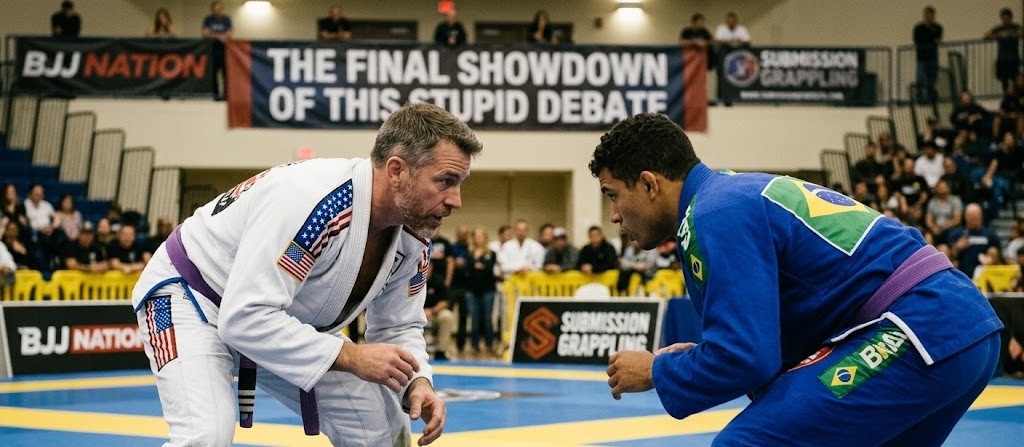
Every BJJ practitioner knows the creation myth by heart, Mitsuyo Maeda lands in Brazil, teaches Carlos Gracie, Hélio adapts the art for the smaller man, and decades later, Rorion and Royce bring the “Gentle Art” to the United States via UFC 1 to show a naive American public what ground fighting actually looks like.
It’s a fantastic story. It’s also wildly incomplete, bordering on incorrect.
While Brazilian Jiujitsu is undeniably Brazilian by its very nature, culture, and specific positional evolution, the broader world of submission grappling, Jiujitsu, and catch wrestling didn’t wait for the Gracie family to cross the hemisphere. In fact, North America was already a hotbed of brutal submission fighting decades before the first Gracie academy ever opened its doors in Rio de Janeiro.
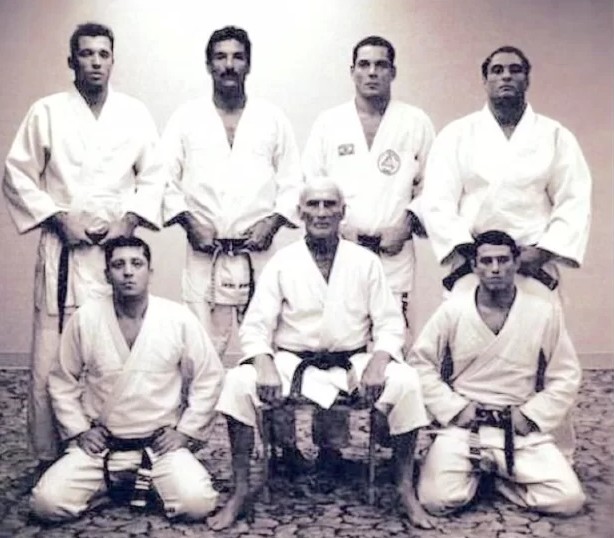
The Familiar Legend: BJJ’s Brazilian Birth
When Kodokan Judo master Mitsuyo “Conde Koma” Maeda settled in Belém around 1914, he planted the seeds of a martial arts revolution. Through his instruction of Carlos Gracie and the lesser-known but equally vital Luiz França, a highly specific branch of grappling was born.
The Brazilians did something magical, they weaponized the guard, refined the lever systems for asymmetric combat, and created a hyper-effective sport and self-defense ecosystem. BJJ as we know it, the culture of the gi, the specific positional hierarchy, and the lifestyle, is a product of Brazil, but the concept of folding a human being into a pretzel via joint locks and chokes? That was already a thriving American pastime.
American Jiujitsu: Jiujitsu In The White House (1904)
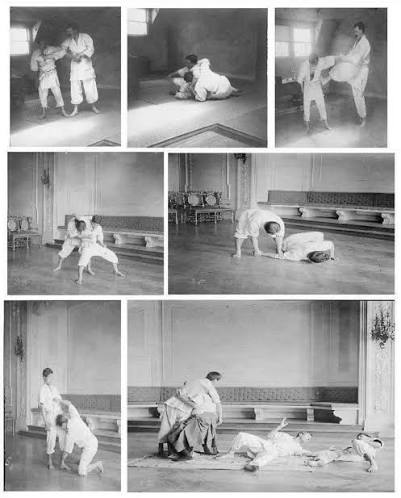
Long before Rorion Gracie was teaching challenges in a Torrance garage, Japanese Jiujitsu was already making waves in mainstream American culture.
In 1904, legendary Kodokan master Yamashita Yoshiaki traveled to Washington, D.C., and actually taught Jiujitsu to President Theodore Roosevelt right inside the White House. Roosevelt was so enamored with the art that he had a training mat installed and regularly practiced the sport.
More importantly, Mitsuyo Maeda himself didn’t just spawn the Brazilian lineage. A full decade before he ever stepped foot in Brazil, Maeda, alongside Tsunejiro Tomita, moved to New York City in 1904 to open a Jiujitsu and Judo club. Maeda spent years traveling through New York, Georgia, and North Carolina, engaging in mixed-style prize fights against American boxers and wrestlers.
Other Japanese pioneers, like Katsukuma Higashi and Taro Miyake, were also actively teaching and competing in the U.S. during this era. Higashi even co-authored The Complete Kano Jiu-Jitsu in New York in 1905 years before Carlos Gracie was even born.
Catch Wrestling: America’s Original Submission Art
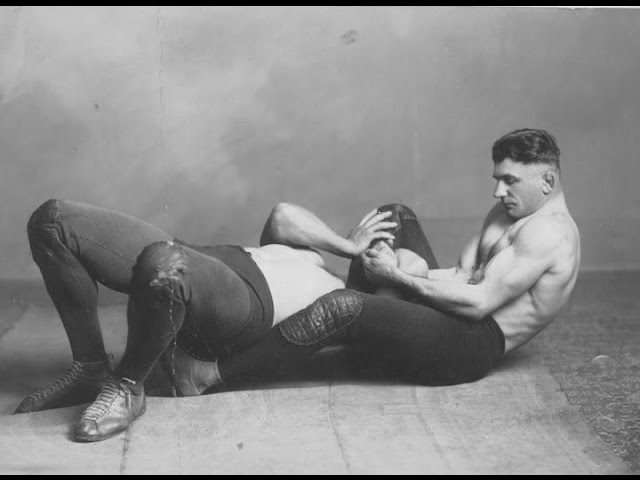
While Japanese jujutsuka were touring the East Coast, a terrifyingly effective submission grappling art was dominating the American heartland, Catch-As-Catch-Can Wrestling.
Originating from the rough mining and industrial towns of Lancashire, England, catch wrestling exploded in the United States during the late 19th and early 20th centuries. Unlike modern freestyle or Greco-Roman wrestling, historic catch wrestling allowed, and actively encouraged, submissions, known colloquially as “hooks”.
- The Carnival Cruising Ground: Catch wrestlers traveled with carnivals, offering cash prizes to any local tough guy who could survive a match without being pinned or forced to tap out. To protect their money, these “hookers” developed hyper-aggressive joint locks, neck cranks, and chokes designed to end fights instantly.
- The Legends: Icons like Martin “Farmer” Burns, Frank Gotch, and Evan “Strangler” Lewis (famous for his brutal chokeholds) were household names long before the Gracie name existed.
- The Cross-Pollination: The worlds of Jiu-Jitsu and Catch Wrestling clashed frequently. In 1914, American catch wrestler Ad Santel fought Japanese Judo champion Tokugoro Ito, defeating him with a devastating slam. Interestingly, Mitsuyo Maeda himself spent years competing under catch wrestling rules during his global travels to sharpen his groundwork before moving to Brazil.
| Era | Region | Key Figures | Primary Style |
| Late 1800s – Early 1900s | United States | Frank Gotch, Farmer Burns, Ad Santel | Catch-As-Catch-Can |
| 1904 – 1910 | United States | Yoshiaki Yamashita, Mitsuyo Maeda, Katsukuma Higashi | Kodokan Judo / Japanese Jiujitsu |
| 1914 – 1925 | Brazil | Mitsuyo Maeda, Carlos & Hélio Gracie, Luiz França | Brazilian Jiujitsu Evolution |
Rewriting The Narrative
When we look at the modern landscape of grappling, specifically the explosive rise of No-Gi submission grappling (typified by events like ADCC), we see an art form that looks just as much like old-school American catch wrestling as it does traditional Brazilian Jiujitsu. The heavy emphasis on leg locks, aggressive top pressure, and the absence of the traditional kimono bridges the century-old gap between the two styles.
Ultimately, acknowledging that submission grappling predated the Gracies in the United States by decades doesn’t diminish what the Gracie family achieved. They didn’t invent the concept of submission, but they systematized, marketed, and revolutionized ground fighting in a way no one else had.
The next time you step onto the mats, remember, you aren’t just inheriting a Brazilian tradition. You are stepping into a profound, pan-American legacy of mat-burn, leverage, and human chess that has been unfolding across both hemispheres for well over a hundred years.


