

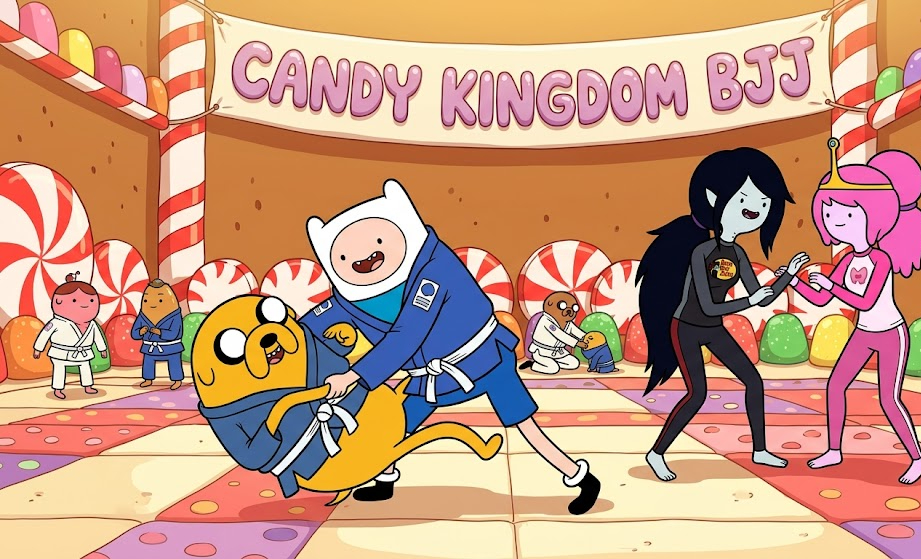
At first glance, Cartoon Network’s Adventure Time is a colorful, surreal journey about a boy, a magical dog, and a post-apocalyptic world filled with candy people, but look a little closer and you’ll find that the Land of Ooo is secretly a masterclass in the philosophy of the gentle art.
Whether you’re a fresh white belt trying to survive your first warm-up or a seasoned black belt navigating a competitive plateau, here are the top six lessons, themes, and concepts from Adventure Time that you can take straight to the mats.
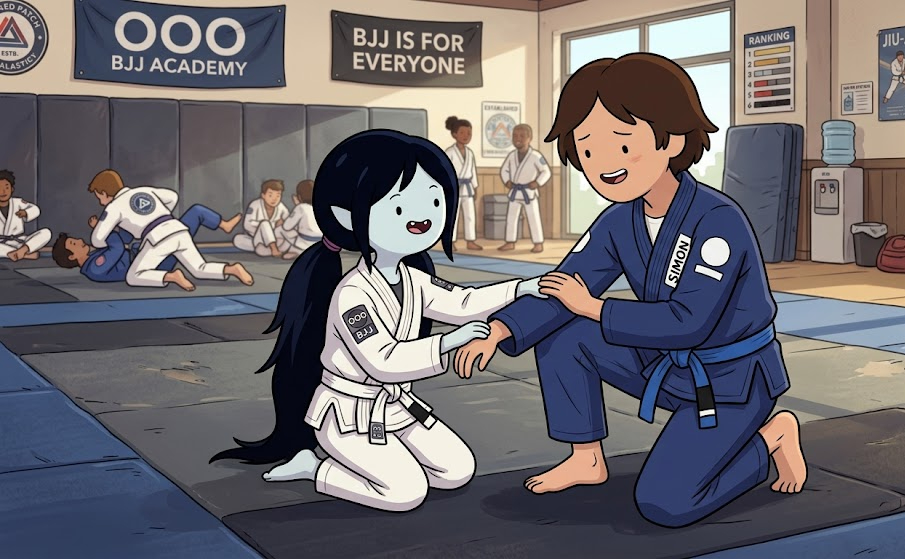
6. “Everything Stays”: The Eternal Return of the Fundamentals
The hauntingly beautiful song Everything Stays, written by Marceline the Vampire Queen, contains a profound truth about time and change:
“Everything stays right where you left it. Everything stays, but it still changes. Ever so slightly, daily and nightly, in little ways, when everything stays.”
If you stick around in martial arts long enough, you realize that the sport is cyclical. Fancy, inverted, matrix-style guards will trend and fade, but the fundamentals always stay right where you left them. However, your relationship to those fundamentals changes. A basic scissor sweep or cross-collar choke feels completely different to a white belt than it does to a black belt. The move hasn’t changed, but you have. Your understanding of leverage, micro-adjustments, and weight distribution evolves “ever so slightly, daily and nightly,” proving that mastery isn’t about learning 10,000 moves, but practicing a few fundamentals 10,000 times.
5. The Hall Of Egress: Navigating The BJJ Plateau
In the episode “Hall of Egress,” Finn finds himself trapped in a sensory-deprivation dungeon. Every time he opens his eyes, the maze resets, trapping him in a loop. He only escapes when he realizes he has to close his eyes permanently, rely entirely on feeling, and navigate the world upside down and backwards.
This is the perfect metaphor for the dreaded jiujitsu plateau known as “the bluubelt blues”.
You will hit points in your training where your favorite moves stop working, and you feel completely stuck. Standard logic dictates you should just train harder, but often, that just keeps you trapped in the same loop. Escaping a plateau requires you to “close your eyes” to your old habits. You have to abandon your comfort zones, try completely different guards, or focus purely on feel and timing rather than forcing familiar pathways.
4. The Grass Sword: Weaponizing Your Flaws and Quirks
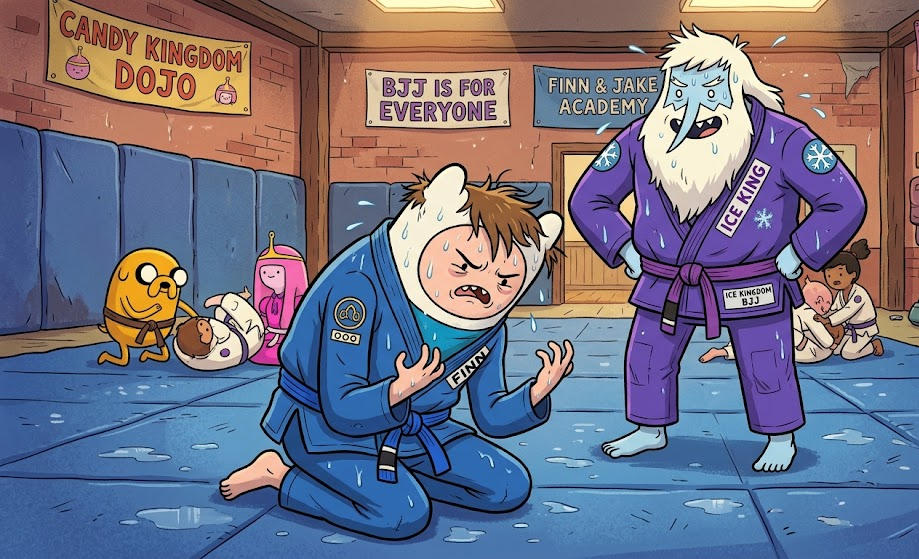
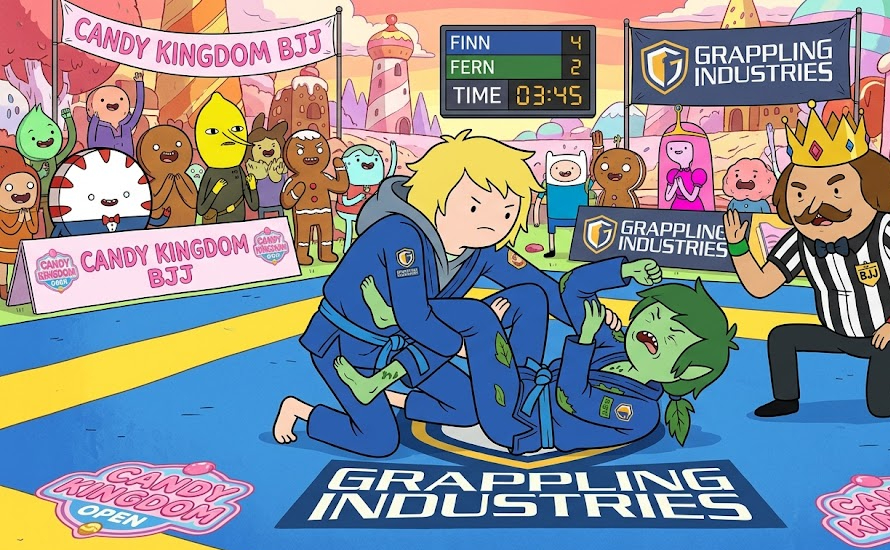
In Season 5, Finn acquires the Grass Sword, a cursed blade that binds itself to his right arm. Initially terrified of the curse, Finn eventually learns to accept it. Because he embraces the weird, unpredictable nature of the sword, it becomes his most lethal asset, acting almost instinctively to protect him.
In BJJ, we all have “curses.” Maybe you have incredibly short legs, making traditional closed guard difficult. Maybe you lack explosive speed, or you’re smaller than everyone else in the room.
Instead of wishing you had someone else’s attributes, the goal is to weaponize your specific anatomy and quirks. Short legs? Become a leg-locking, heel-hooking terror. Slow and heavy? Perfect the art of pressure passing and suffocating side control. Accept your “curse” and turn it into your signature game.
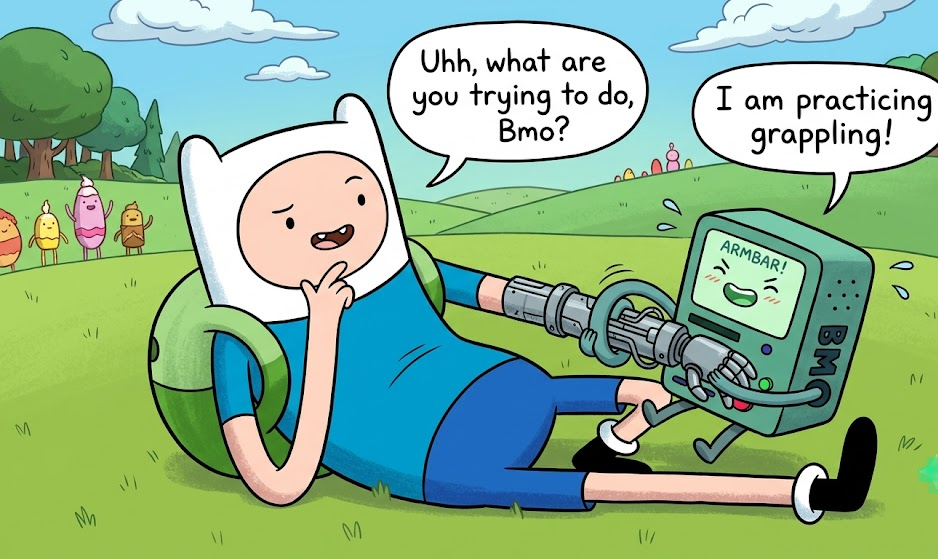
3. Finn’s Missing Arm: Overcoming Injury And Modifying Your Game
Throughout the series, Finn the Human faces a recurring destiny, losing his right arm. When it finally happens, it doesn’t end his career as a hero. Instead, he adapts. He uses a flower prosthetic, a mechanical arm, and eventually learns to fight with a completely altered center of gravity and new tactical tools.
Every long-term martial artist will face the reality of injury or physical limitation. Whether it’s a blown knee, a bad back, or just the natural slowing down that comes with aging, your body will change.
Finn teaches us that an injury isn’t the end of your journey; it’s the catalyst for a new evolution. When you can no longer rely on your favorite guard passing sequence due to a bad ankle, you are forced to develop your open guard. You adapt, modify your tools, and build a more resilient game.
2. Jake’s Shapeshifting: Fluidity And Adaptability Over Rigidity
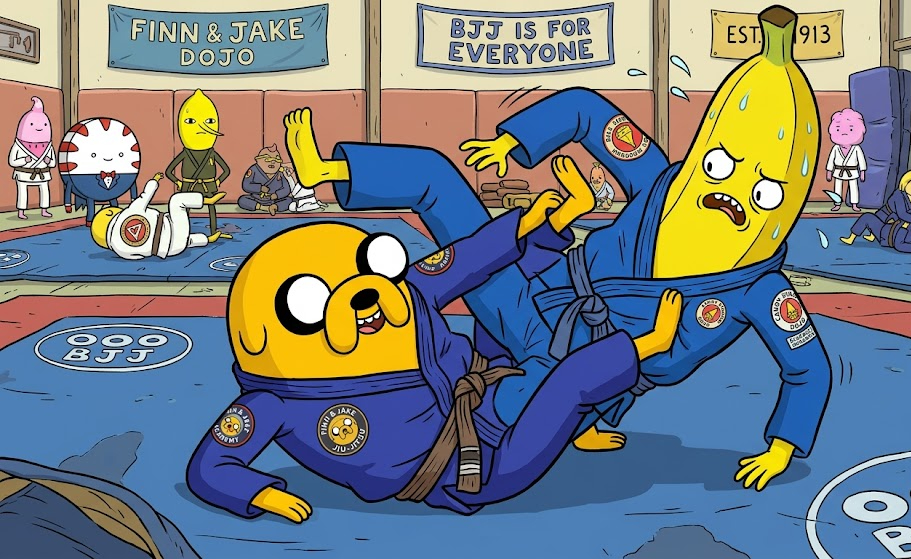
Jake the Dog’s superpower is his ability to stretch, shrink, and mold his body into any shape imaginable. He doesn’t fight against a heavy object with brute force; he flows around it, grows a pocket to catch it, or shrinks to escape it.
In grappling, rigidity is your enemy.
- Stiff-arming an opponent wastes precious energy.
- Tensing up makes you easy to sweep.
- Forcing a technique that isn’t working leads straight into a counter-attack.
Like Jake, a good grappler acts like fluid. When an opponent applies heavy top pressure, you don’t push directly back, you frame, create an angle, and find the empty space to escape. Cultivating a stretchy mindset allows you to adapt to whatever style your opponent throws at you.
1. Jake’s Golden Rule: Embracing The White Belt Grind
It is arguably the most famous quote from the entire series, and it should be plastered on the ceiling above every gym’s mat space:
“Sucking at something is the first step towards being sorta good at something.” — Jake the Dog
There is no sport on earth that humbles a person quite like submission-grappling. Your first few months (and honestly, years) are a masterclass in getting smashed, swept, and tapped out.
Jake’s philosophy is the ultimate antidote to the ego-driven anxiety that causes so many beginners to quit. Growth isn’t linear, and it certainly isn’t pretty. To get to the point where you are hitting clean sweeps and effortless submissions, you have to be willing to look foolish, make mistakes, and embrace the suck.
| Adventure Time Theme / Concept | The Core Philosophy | BJJ & Martial Arts Application |
| 1. Jake’s Golden Rule | “Sucking at something is the first step towards being sorta good at something.” | Embracing The White Belt Grind: Check your ego at the door, accept that growth isn’t linear, and understand that making mistakes is a requirement for mastery. |
| 2. Jake’s Shapeshifting | Stretching, shrinking, and molding around obstacles instead of fighting them with brute force. | Fluidity Over Rigidity: Stiff-arming and tensing up wastes energy. Instead, frame, find the empty space, and fluidly adapt to your opponent’s pressure. |
| 3. Finn’s Missing Arm | Adapting to a major physical loss by utilizing new prosthetics and shifting tactics. | Overcoming Injury: Injuries aren’t the end of the road, they are catalysts to evolve your game, develop alternative guards, and build a more resilient style. |
| 4. The Grass Sword | Accepting a weird, unpredictable “curse” and turning it into a lethal, instinctive weapon. | Weaponizing Your Quirks: Stop wishing for different physical attributes. Turn your specific body type, short legs, or lack of speed into your signature, specialized game. |
| 5. The Hall Of Egress | Escaping a repeating trap by closing your eyes and navigating entirely by feel. | Navigating The Plateau: When your favorite moves stop working, stop forcing them. Break through plateaus by abandoning your comfort zones and focusing on micro-adjustments and timing. |
| 6. “Everything Stays” | “Everything stays right where you left it… but it still changes, ever so slightly.” | The Return To Fundamentals: Flashy trends come and go, but the basic concepts always remain. The move doesn’t change as you rank up, your deep, subtle understanding of it does. |
Happening Happens
Adventure Time reminds us that the journey of a warrior isn’t about being invincible from day one. It’s about the friends you make along the way, the willingness to look foolish, the resilience to rebuild after a loss, and the joy of the adventure itself. So next time you’re tying your belt and stepping onto the mats, channel your inner Finn and Jake. It’s time to roll.


