

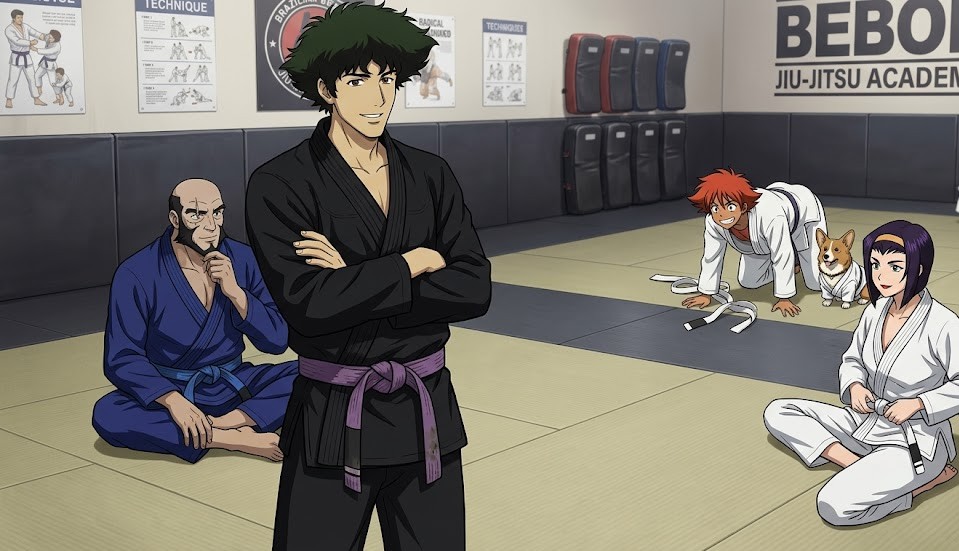
There is a distinct overlap between the subcultures of combat sports and anime, but few series hold a more revered status among martial artists than Shinichirō Watanabe’s 1998 masterpiece, Cowboy Bebop.
On the surface, it’s a space-western about a dysfunctional crew of bounty hunters scraping by on the fringes of the solar system, but underneath the jazz-infused soundtrack and sci-fi aesthetic lies a profound exploration of movement, philosophy, and combat. The show’s protagonist, Spike Spiegel, is widely recognized as one of the best depictions of a martial artist in fiction, explicitly practicing Bruce Lee’s philosophy of Jeet Kune Do.
Whether you are a white belt trying to survive the meat grinder or a black belt refining your flow state, the underlying themes of Cowboy Bebop translate perfectly to the mats. Here is our definitive ranking of the top six lessons Cowboy Bebop teaches us about BJJ, grappling in a boarder sense, and the martial arts way of life.
6. “You’re Gonna Carry That Weight”
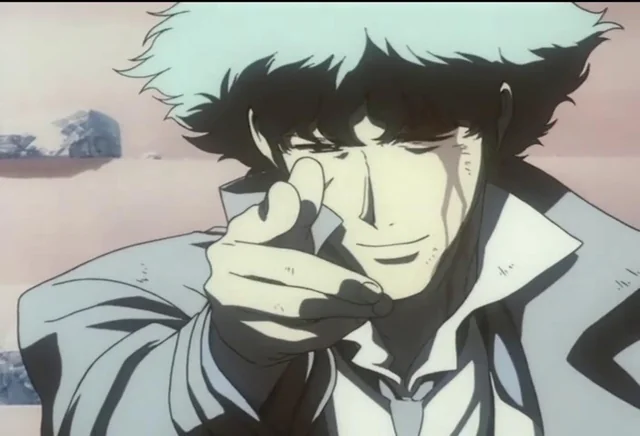
Every single episode of Cowboy Bebop ends with a title card, but none are more famous than the final looming reminder: “You’re gonna carry that weight.” Within the show, it refers to the emotional baggage and inescapable pasts of the characters.
On the mats, this translates literally and metaphorically. Jiujitsu is a game of heavy burdens. You carry the physical weight of injuries, aging joints, and grueling training camps. More importantly, you carry the mental weight of bruised egos, plateaus, and failed tournaments.
The Mat Lesson: Growth in grappling isn’t about escaping the weight, it’s about developing the structural and mental strength to carry it. Every tap, every setback, and every sore muscle is a piece of baggage you choose to carry forward to become a sharper martial artist.
5. The Bebop Ecosystem (The Value Of An Eclectic Academy)
The crew of the Bebop, a cynical ex-cop (Jet), a haunted former criminal (Spike), a debt-ridden grifter (Faye), a eccentric teenage hacker (Ed), and a hyper-intelligent Corgi (Ein), should not work together. They argue, steal each other’s food, and threaten to leave. Yet, when the chips are down, their radical differences complement each other perfectly, allowing them to survive the harshest corners of the galaxy.
Look around your local BJJ academy during the evening advanced class. You’ll find a microcosm of the Bebop:
- An IT professional who plays a hyper-analytical lapel guard.
- A former collegiate wrestler who only knows maximum pressure.
- A hyperactive teenager flying through berimbolos.
- A seasoned veteran who uses old-school pressure to survive.
Why It Matters: You cannot build a complete Jiujitsu game by only rolling with people who move exactly like you. The beauty of a great academy is the diversity of its ecosystem. The weirdos, the athletes, and the tacticians all force you to solve different problems, accelerating your evolution.

4. “Whatever Happens, Happens”
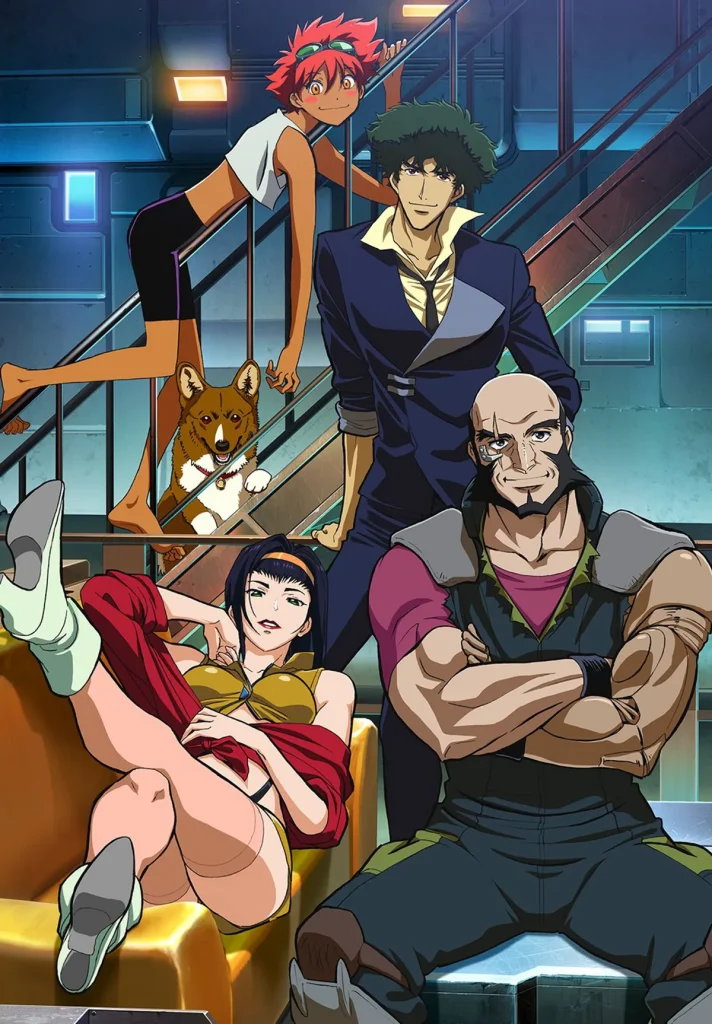
Spike Spiegel’s defining catchphrase, delivered with a shrug of his shoulders, is the ultimate expression of stoicism; “Whatever happens, happens.” It isn’t an expression of apathy, it is an expression of radical acceptance. Spike knows that panicking in the middle of a gunfight or a brawl will only get him killed.
There is no place where panic is more lethal than bottom mount or inside a tight submission. When a 230-pound ultra-heavyweight is smashing your jaw with a cross-face, panicking burns your oxygen, compromises your posture, and hands them the submission.
The Stoic Grappler’s Framework
- Assess: Acknowledge the danger without emotional panic.
- Accept: Accept that you are currently in a terrible position; wishing you weren’t won’t change the reality of the cross-face.
- Act: Breathe, find your frames, and systematically work your escape.
3. The Jazz Of The Scramble
Cowboy Bebop is heavily structured around the philosophy of jazz music. Jazz relies on a deep understanding of foundational scales, but the magic happens when the musicians begin to improvise, reacting to each other in real-time.
Jiujitsu is the physical manifestation of jazz. While drilling a technique 1,000 times gives you the foundational scales, a real match is chaotic. If you enter a roll with a rigid, unyielding script (e.g., “I must get the underhook, pass to the left, and hunt the armbar”), you will stumble the moment your opponent throws an unexpected wrench into the gears.
The best grapplers are improvisational masters. They don’t force a sweep that isn’t there, they read the opponent’s kinetic energy, accept the scramble, and let their subconscious body mechanics dictate the next note.
2. Fluidity Over Force, Be Like Water
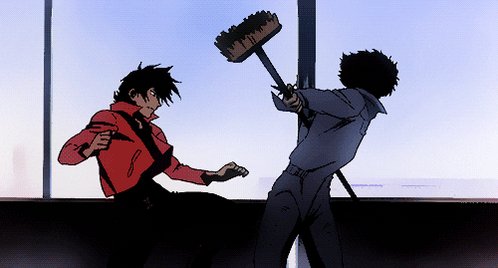
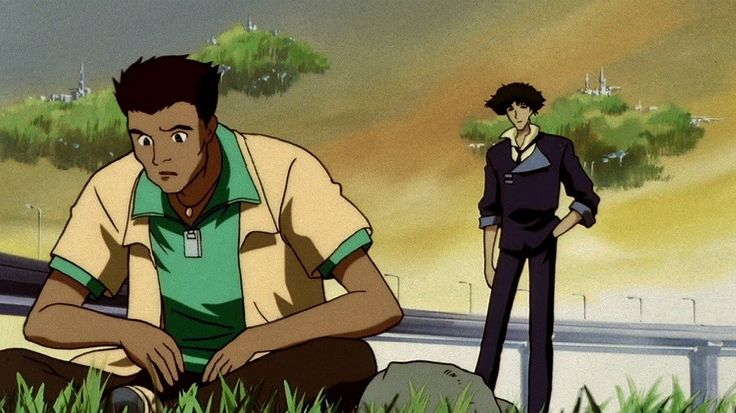
In Session 8, “Waltz For Venus,” Spike takes on a clumsy student named Rocco and explains the core of his combat philosophy. The dialogue is a direct homage to Bruce Lee, but it perfectly encapsulates the ultimate goal of Jiujitsu, maximum efficiency, minimum effort.
“You win by being like water. Flowing, flexible, adapting to the container that holds you. Don’t force it, let it happen… You look at the opponent’s movements and you just redirect their energy. You don’t resist, you just flow with them.” — Spike Spiegel
When a rolling partner uses explosive, muscular force to pass your guard, meeting that force head-on creates a collision where the stronger athlete wins. By being fluid, collapsing a hook, framing off a hip, and letting their momentum carry them past your torso while you take their back, you achieve the effortless grace that makes grappling an art form.
1. Absorb What Is Useful/Formlessness And Finding Your Own Jiujitsu
Spike Spiegel’s combat style is heavily based on Jeet Kune Do, a philosophy that rejects rigid styles and dogmatic traditions. Lee’s most famous axiom was to “absorb what is useful, discard what is useless, and add what is specifically your own.”
This is the ultimate evolution of a martial artist, and it perfectly maps onto the BJJ journey!
- The White/Blue Belt Phase: You copy your instructor verbatim. You learn the rigid, traditional dogmas of the art because you need a foundation.
- The Purple/Brown Belt Phase: You begin to experiment. You realize that because you have short legs, the body-lock pass works better for you than the toreando pass. You begin discarding what doesn’t fit your anatomy or temperament.
- The Black Belt Phase: You achieve formlessness. Your Jiujitsu becomes an extension of your personality. It is no longer the academy’s style, it is your style.
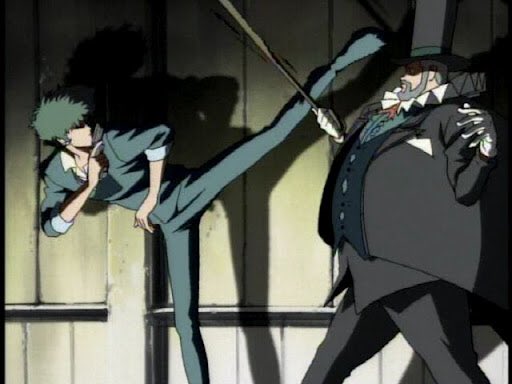
Cowboy Bebop endures because its characters refuse to be neatly boxed into archetypes, they are messy, adaptive, and uniquely themselves. On the mats, the ultimate goal isn’t to be a clone of your favorite world champion. The goal is to gather the tools, study the philosophy, and ultimately forge a martial arts style that belongs entirely to you.


