

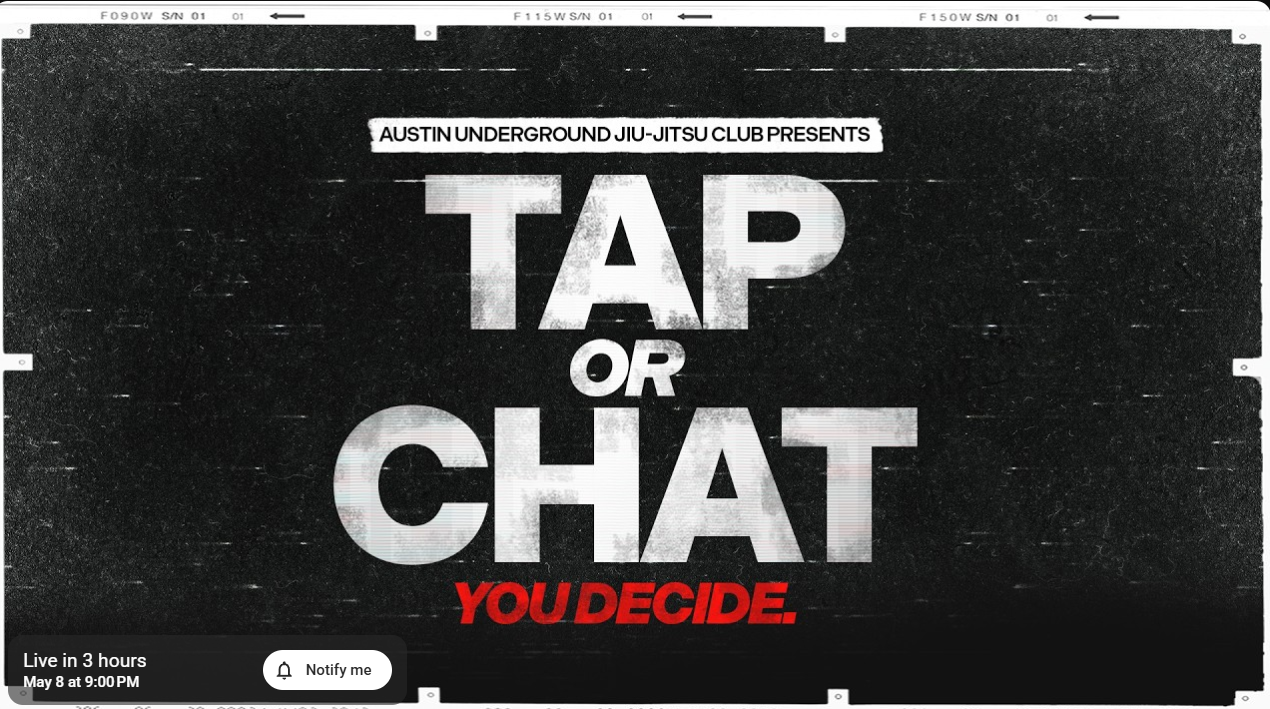
Jiu-jitsu has tried just about everything to decide who wins a match.
Points. Advantages. Referee decisions. Submission-only formats. Overtime systems invented by people who apparently hate joy. Entire rulebooks written to answer the question, “What if nothing happens for nine minutes, but one guy’s knee line looked slightly more ambitious?”
And now, in the year of our Lord, we have arrived at the next logical step:
Let the chat decide.
That’s the premise behind Tap or Chat, FloGrappling’s free live show on YouTube, where athletes can either win the old-fashioned way — by making the other person quit — or by somehow convincing the internet they were the better grappler.
Yes. The same internet that brought you comment sections, conspiracy threads, and men confidently explaining heel hooks with the emotional maturity of wet drywall.
This is the judge now.
Finally, a Jiu-Jitsu Format for People Who Think “I’d Have Done Something Different There”
Tap or Chat is built around a wonderfully unhinged concept: if nobody gets submitted, the fans decide the winner.
So instead of leaving the result in the hands of trained officials, we now hand it over to the digital public — a population best known for typing “robbery” the second their favorite guy doesn’t win, even if he spent six minutes getting body-locked into another dimension.
It’s beautiful, really.
For years, jiu-jitsu fans have wanted more say in the sport. Mostly they’ve expressed that by screaming online after every decision. Flo has apparently decided to skip the middleman and just make the screaming part of the format.
Efficiency.
At Last, a Ruleset That Rewards Technique, Aggression, and Vibes
The funny thing is, Tap or Chat might actually work.
Traditional jiu-jitsu scoring often feels like it was developed in a cave by monks trying to punish charisma. You can have a match full of subtle positional exchanges and technical nuance, and by the end half the audience is staring at the screen like they’ve just watched two accountants wrestle over a folded fitted sheet.
But a fan-voted system changes the incentives.
Now it’s not just about controlling position or edging ahead in some obscure scoring sequence that only three black belts and a traumatized referee understand. Now it’s about looking like you’re winning.
You know — the way almost every human being has judged fights since the beginning of time.
Suddenly, pace matters. Submission attempts matter. Big moments matter. The audience matters. If one athlete spends the entire match carefully constructing an argument for why almost passing should count as dominance, and the other guy comes forward trying to remove limbs, the crowd might actually prefer the second one.
A shocking development.
Of Course, Letting the Crowd Decide Could Go Horribly Wrong
There are risks here.
The internet is not a sacred council of wise elders. It is a deeply unstable organism fueled by energy drinks, bias, and poor spelling. There is a very real possibility that someone could lose a match because the other guy had better hair, more followers, or a username people recognized from Instagram reels.
A flashy scramble might outweigh five minutes of actual control. A near-submission could matter more than solid positional work. Someone could probably win an audience vote just by pointing at the camera and acting like a WWE midcard heel.
And honestly?
That sounds way more entertaining than another seven-minute match where one guy’s entire strategy is making you whisper, “I guess he’s technically doing something.”
This Is Probably Terrible for Purists, Which Makes It Even Better
The purists are likely already sweating through their rashguards.
There will be complaints about integrity. About nuance. About how the chat cannot possibly appreciate the finer details of inside position, kuzushi, and lower-body dilemmas. Somewhere, a guy who owns three instructionals on seated guard is preparing a 19-part Instagram story about why fan voting is the death of the sport.
Relax, professor.
Jiu-jitsu has a viewer problem. More specifically, it has a “most normal people would rather do literally anything else” problem. The sport is full of incredible athletes and high-level technique, but it has often packaged itself with the entertainment instincts of a DMV waiting room.
So if someone comes along and says, “What if we made this more interactive, more immediate, and less dependent on a spreadsheet of imaginary merit?” maybe that’s not such a bad thing.
Not every format needs to be the sacred vessel of technical truth. Some formats are allowed to be fun.
And Let’s Be Honest: Jiu-Jitsu Needed a Little Public Humiliation
One of the best possible side effects of Tap or Chat is that it might force competitors to stop gaming matches like they’re trying to exploit a broken video game patch.
If the crowd has a say, then athletes may actually need to do things.
Push the pace. Attack submissions. Chase finishes. Take risks. Give people a reason to remember the match besides “I think the guy in the black rashguard maybe won because he leaned more persuasively.”
Fan voting, for all its flaws, punishes boredom better than most rulebooks ever have.
And boredom has been getting away with murder in grappling for years.
The Real Genius of Tap or Chat
The real genius here is not that it guarantees fairness. It absolutely does not.
The genius is that it recognizes a truth jiu-jitsu has spent years trying to avoid: if you want people to watch, they have to care.
And people care more when they’re involved.
That’s why live chat exists. That’s why every sport in the modern era is trying to build some kind of interactive feedback loop. That’s why millions of people who couldn’t explain an underhook still love arguing about fights online like they’re members of an athletic supreme court.
Tap or Chat doesn’t pretend the audience is objective. It just accepts that they’re already part of the show.
Which, frankly, is smarter than pretending jiu-jitsu exists in some pure vacuum where every decision is rational and every viewer is a philosopher-king.
Final Thoughts
Tap or Chat may not be the cleanest competitive format ever created.
It may not satisfy the people who believe every jiu-jitsu match should be evaluated by a committee of grim-faced scholars holding clipboards and emotional damage.
But it might do something even more important: make grappling more watchable.
And if that means the occasional result gets decided by an online mob running on caffeine, emotion, and partial technical understanding?
Well, congratulations. That still sounds more transparent than half the judging we already have.
So yes — Tap or Chat is ridiculous.
But it’s the kind of ridiculous jiu-jitsu probably needs.
Because if the choice is between a little chaotic fan participation and another painfully sterile match where both guys pretend almost doing something counts as offense…
Give us the chat.


