

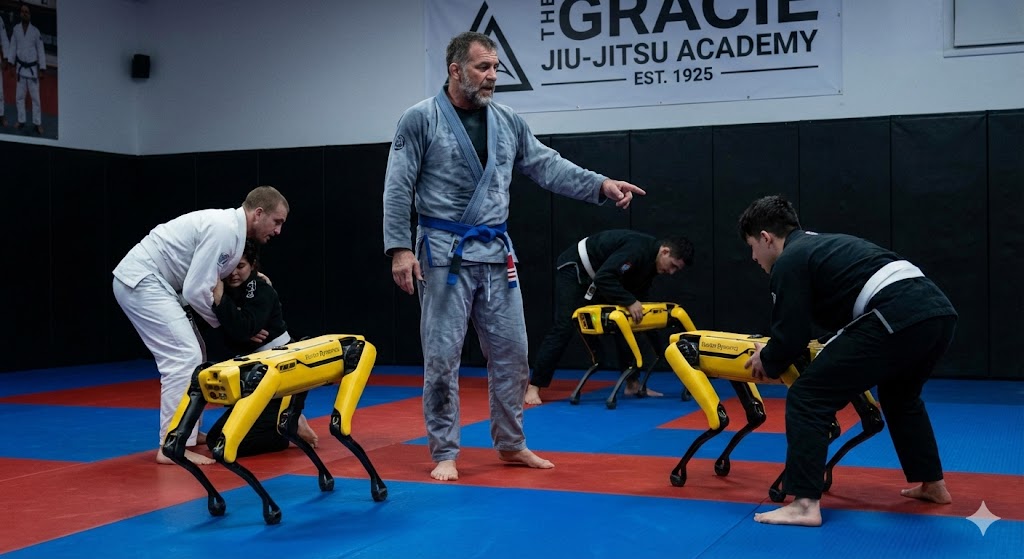
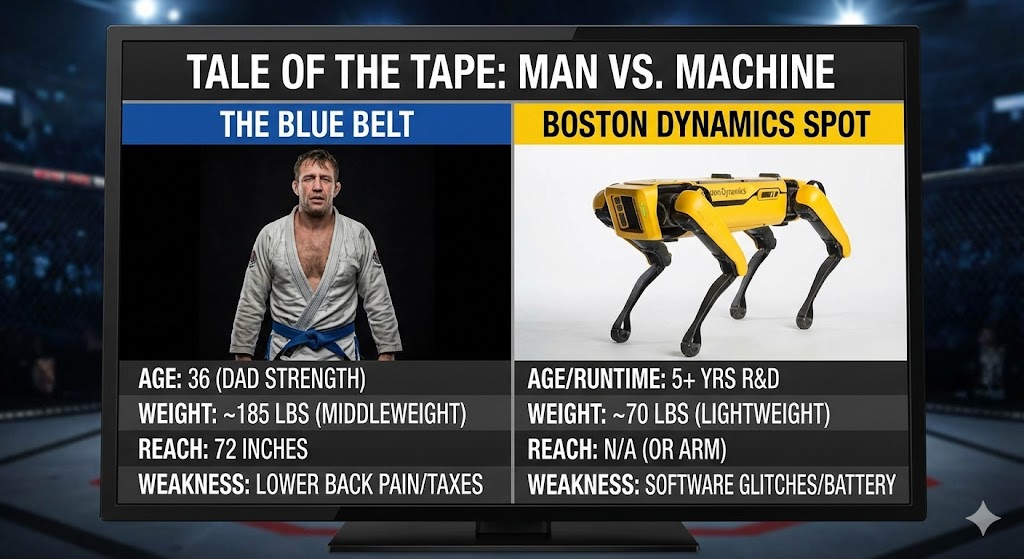
In the ever-evolving landscape of “fights nobody asked for but everyone wants to see,” we move past billionaire cage matches and into the realm of science fiction. Today, we break down a hypothetical clash between a 36-year-old Brazilian Jiu-Jitsu blue belt, likely fueled by cold brew and Ibuprofen, and Boston Dynamics’ quadrupedal wonder, Spot.
Can human technique overcome robotics, or is the future of “the gentle art” simply obsolete against a chassis of industrial-grade components?
Phase 1: The Standing Exchange
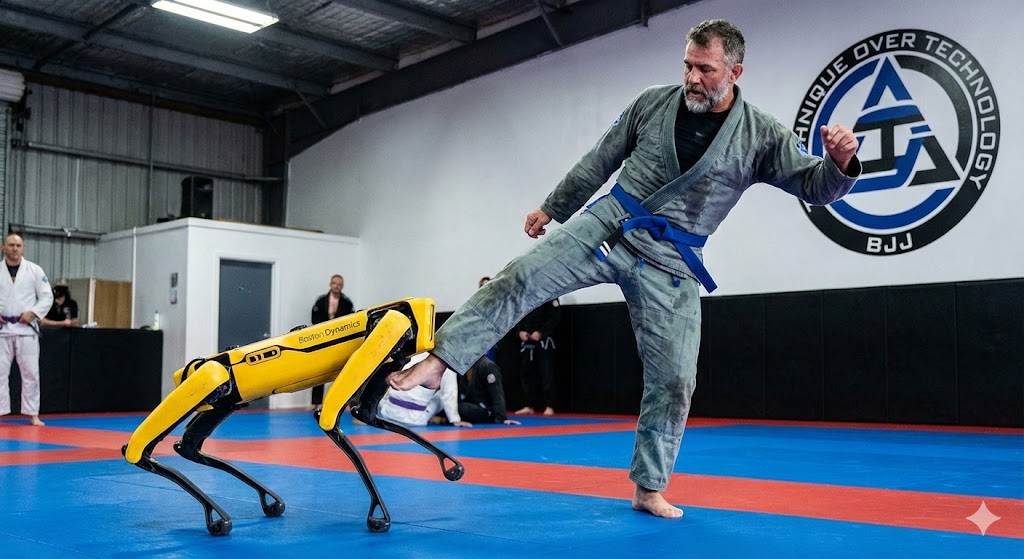
Our 36-year-old protagonist enters the cage with “some striking ability,” which in blue belt terms usually means a decent leg kick and a panic-double-leg setup.
The Reality: Striking a Spot is a recipe for a broken hand. Spot is constructed of aluminum and toughened plastics. While the human might land a few crisp low kicks, Spot’s self-balancing algorithms are world-class. You aren’t knocking Spot out, there is no chin to find, and no vestibular system to rattle.
If the human tries to “box” the robot, they are essentially punching a very expensive, very mobile radiator. The human’s best bet here is a tactical retreat or a clinch.
Phase 2: The Ground Game (The “Blue Belt” Special)
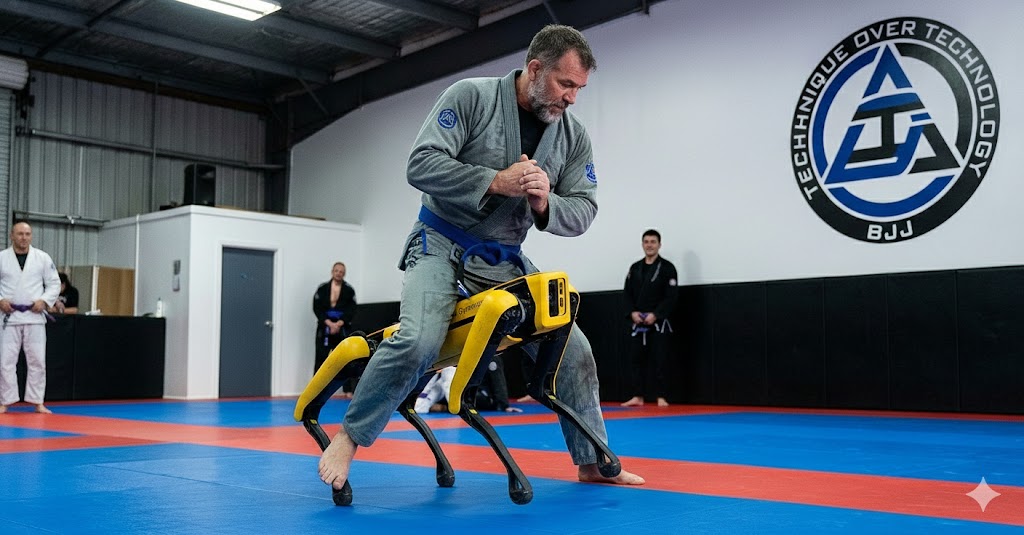
This is where it gets weird. A BJJ blue belt’s instinct is to close the distance, get a grip, and initiate a takedown.
- The Takedown: At 70 lbs, Spot is significantly lighter than the human. A standard blast double-leg would likely send the robot flying. However, Spot’s ability to right itself is legendary.
- The Submission: Herein lies the problem. BJJ is designed for human anatomy.
- Chokes: Spot has no carotid arteries and no trachea. The “Rear Naked Choke” becomes a “Rear Naked Plastic-Squeeze.”
- Joint Locks: You could theoretically attempt an “armbar” on one of the legs, but you are fighting electric motors and carbon-fiber-reinforced actuators. Unless our blue belt is pushing world-class powerlifting numbers, they aren’t snapping a servo.
Verdict: The human dominates via “top pressure,” but lacks a finishing move. It’s a 15-minute grind that ends in a boring Unanimous Decision for the human, provided they don’t gunk up their gi in the robot’s joints.
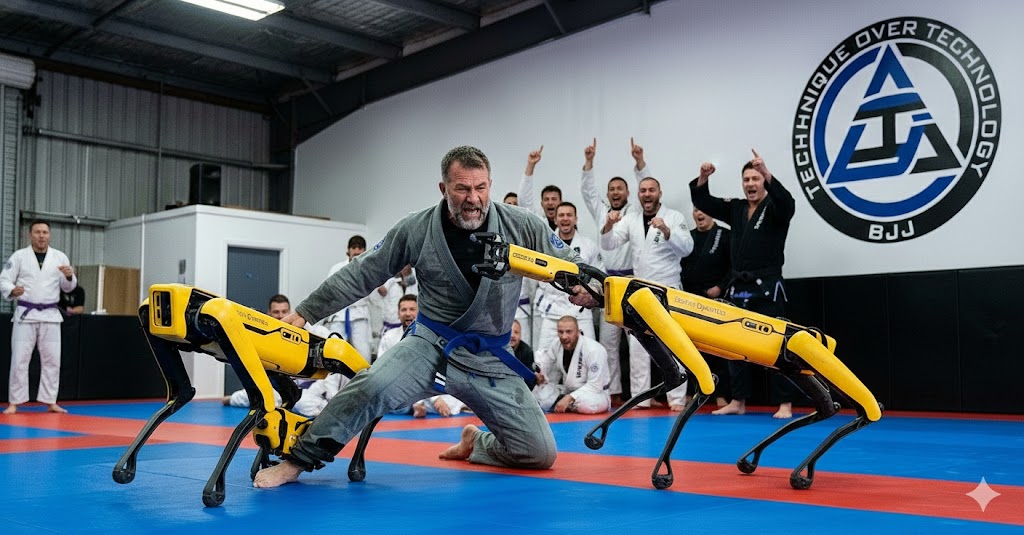
The “Swarm” Factor: How many Spots does it take?
If one Spot is a nuisance, a pack is a nightmare. To actually overpower a 185-lb athletic human, Spot needs to overcome the massive weight and leverage disadvantage.
The Magic Number: Three.
- Spot A (The Anchor): This unit goes for the lead leg. It doesn’t need to “know” BJJ; it just needs to apply 70 lbs of dead weight and high-torque clamping to a human ankle.
- Spot B (The Divider): While the human is busy trying to kick Spot A off, Spot B strikes the midline, using its mass to disrupt the human’s center of gravity and force a fall.
- Spot C (The Finisher): Once the human is on the ground, Spot C utilizes the optional manipulator arm to pin a limb or apply pressure to the torso.
Expert Analysis: At 36, our grappler’s gas tank is a finite resource. Fighting off 210 lbs of coordinated, non-tiring metal (3 units) would lead to muscular exhaustion within three to five minutes. Once the human can no longer bridge or shrimp, the “dogs” have won.
Final Thoughts
While our blue belt friend can likely handle a single robotic pup through sheer size and “old man strength,” the math changes quickly when the cloud network gets involved. If you find yourself in a cage with more than two Boston Dynamics units, it’s time to stop thinking about your guard and start looking for the “off” switch.


